Player retention for youth hockey associations starts with parent feedback.
ClubSat runs parent surveys, anonymous two-way messaging, and coach scorecards for hockey associations, all season long, so you know which families are wavering while you can still change their minds.
No app for parents to install, no survey for your board to build. We run the feedback program. You keep the families.
Families leave for reasons you can fix.
Youth sports clubs lose 20 to 25% of their families every year.1
Most families will never indicate that they are wavering, and by the time you notice, they have already moved on to another association. The reasons families leave follow a consistent pattern and most of them are fixable.
The feedback already exists. It lives in the rink lobby, on the car ride home, and in the parent group chat.
ClubSat gives it a private place to land, so you hear it while there is still time to act on it.
Why families leave hockey associations
- Tier placement
An AAA, AA, or A decision that felt political, with no conversation about development.
- Favoritism
Ice time and line decisions that families read as politics.
- Feeling unheard
A concern raised in December that never got a reply, so they stopped raising them.
- The experience
One of the most expensive youth sports there is, served by a group chat and a silent inbox.
- The calendar
Tryouts start days after the season ends. Families decide during the season.
What a parent feedback program does for player retention
Happier families
Every parent gets a private, anonymous channel and every message gets an answer. A family that feels heard is a family that signs again at tryouts.
Fuller tryout rinks
Retention risk shows up in your data by the holidays, months before tryouts. You fix the fixable problems while the fix still matters.
A calmer association to run
Complaints route to an organized inbox instead of cornering your board members in the lobby. Urgent issues reach you immediately. Everything else waits for your weekly review.
Ready to see it in action?
Join the clubs already using ClubSat to collect structured feedback, resolve issues faster, and strengthen their culture.
See How It WorksFree walkthrough · No commitment required
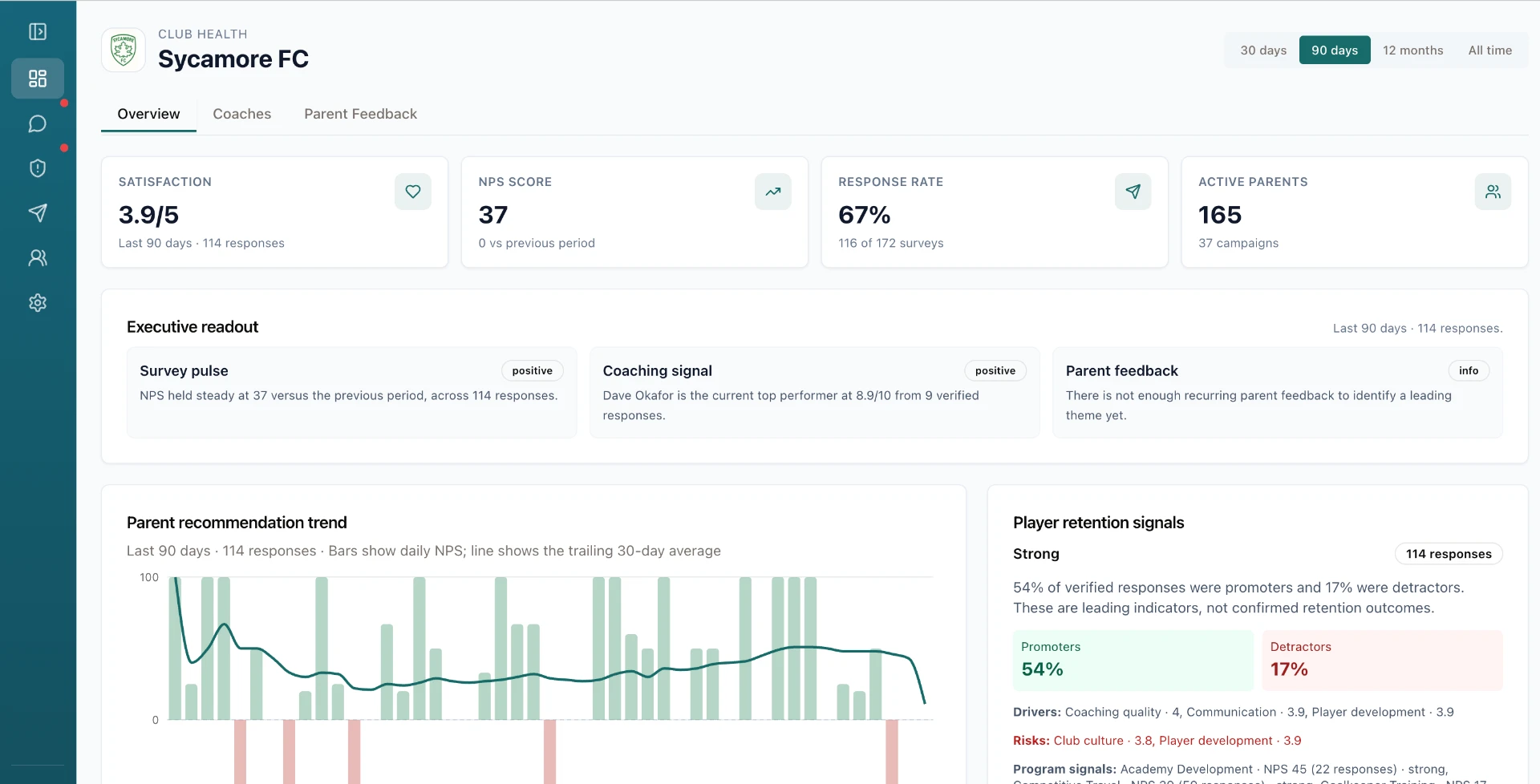
Hockey has its own failure modes.
The rink talks
Hockey communities are small. A frustrated family vents in the lobby between periods, and by Sunday the whole association has heard it.
Give families a private channel so frustration reaches you before it tours the rink.
Tryouts chase the final game
Tryouts land days after the season ends, so there is no off-season to repair a bad year. Families walk in with their minds made up.
Check in all season so you know where you stand long before tryout weekend.
Volunteer boards inherit everything
Board members get cornered at the glass and buried in email threads, with no training for a tier appeal or a conduct complaint.
Route every issue to a triaged inbox with an owner and a due date.
We run the retention loop. You run the association.
- 1
We learn how your association is built
Send a roster export from SportsEngine, Crossbar, TeamSnap, or a spreadsheet. We map your teams, age levels, and coaches.
- 2
Families get a voice all season
Short, anonymous check-ins land at the moments that decide re-signing. One tap to answer, so you hear from the families who never email.
- 3
Risk surfaces while it's fixable
AI triage flags an about-to-leave family or a safety issue immediately, and coach and team trends show where loyalty is building or eroding.
- 4
You close the loop, families stay
Every parent gets an answer, with drafts ready to send, and bigger issues become cases with an owner and a due date.
Why this works
A standard measure
We use the Net Promoter System, asked the same way every survey, so you can compare coaches, age levels, and seasons instead of guessing from anecdotes.
Service recovery
Decades of customer research show the same pattern: a family whose problem gets handled well becomes more loyal than one that never had a problem. The response matters more than the complaint.
Anonymity
Parents hold back face-to-face because the stakes for their kid are too high. Anonymous channels surface what lobby conversations never will, and the data shows engagement turns negative sentiment around more than half the time.
A 1,400-player club turned its numbers around in one season.
Wisconsin United FC started the program with an NPS of −7 and a director drowning in scattered complaints. Two seasons of listening and follow-through later: a 20% enrollment gain.
Wisconsin United FC · 1,400-player soccer club · ClubSat customer since spring 2026
We started in soccer. The playbook is the same wherever families pay serious dues and decide each year whether to come back.
Read the Wisconsin United case study →Less than one family's ice bill.
One AA family pays more for a season of hockey than ClubSat costs for your whole association, every team, all year.
- Managed setup, onboarding, and roster updates
- Season-long surveys, with post-tryout and exit surveys
- Anonymous two-way messaging and the triaged inbox
- Coach and team scorecards, board-ready reporting
- No per-player fees. Not satisfied in 30 days? Full refund.
Hockey association surveys and retention, answered
Why do families leave hockey associations?
What should a hockey association ask parents in a season survey?
When should we survey parents during the season?
Do parents answer anonymously?
Does ClubSat do coach evaluations?
How is this different from a Google Form?
How much does ClubSat cost?
Feedback only works if someone acts on it.
ClubSat runs the retention loop with you: surveys, triage, recommended replies, and reporting, from the first puck drop to tryout weekend.
1. Year-over-year player retention at U.S. youth soccer clubs averages 67–78% depending on age group (Sprocket Sports Player Retention Report, 2025); registry data across 420,000+ licensed youth athletes shows about one in five do not continue each year (Finnish Olympic Committee, Sporttidata); a peer-reviewed analysis of youth football found a mean annual dropout rate of 23.9% for ages 10–19 (Frontiers in Psychology, 2025).